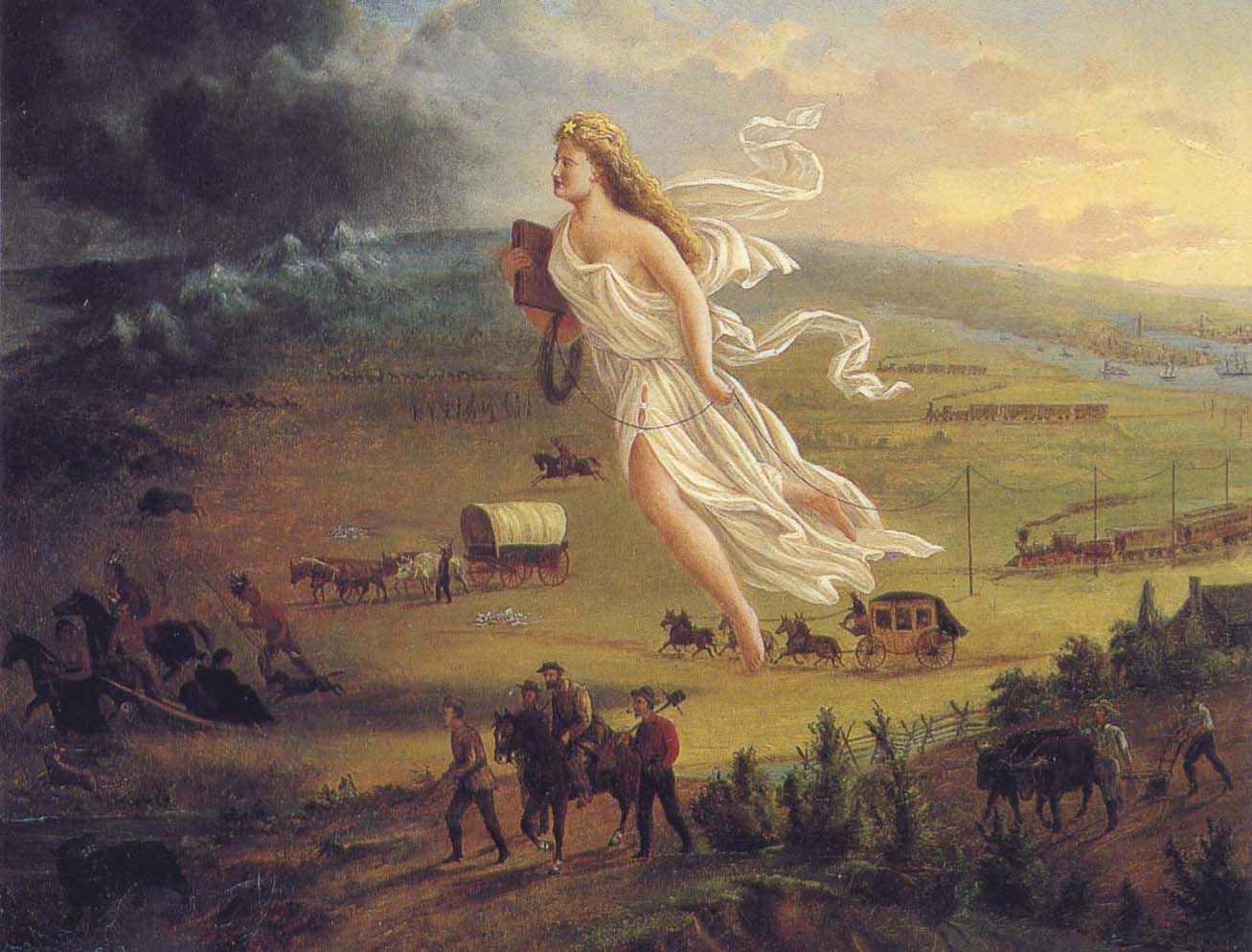
This painting is titled American Progress and was created by John Gast in 1872. This piece of art is the seminal work representing the term Manifest Destiny.
For the comments section this week, provide a definition for Manifest Destiny. Then, give at least two (2) examples from American Progress that demonstrate/provide evidence for the definition you posted.
Saints & Sinners is an extension of my Advanced US History class. This blog is a place for civil discourse, critical thinking and new ideas. The goal of these entries is to challenge your current viewpoint and encourage the development of logical arguments.
Monday, April 11, 2016
Saturday, April 2, 2016
Political Cartoon: King Jackson
Monday, March 21, 2016
Political Parties: Whigs vs. Democrats
The first political factions were the Federalists vs. Democratic-Republicans. As we moved into our second generation of leaders, two new parties emerged: Democrats vs. Whigs.
Visit this website and this website to get a feel for what each stood for in the 19th century.
For the comments section, summarize the beliefs of EACH party. Also, which party would you have joined if you were alive back then?
Visit this website and this website to get a feel for what each stood for in the 19th century.
For the comments section, summarize the beliefs of EACH party. Also, which party would you have joined if you were alive back then?
Tuesday, March 15, 2016
Andrew Jackson: His First Inauguration
So...Jackson is somewhat of a game-changer. He was certainly the first of his kind to hit the national spotlight. As you will see throughout the coming weeks, much of what made him unique and popular also led to his controversial actions while President.
This week, you will read this account of Jackson's 1829 Inauguration. Answer the following questions for the blog:
1) Did Jackson's Inauguration seem "presidential" to you? Why or why not?
2) Why were people reacting this way to Jackson when they had not acted this way for Presidents 1-6?
This week, you will read this account of Jackson's 1829 Inauguration. Answer the following questions for the blog:
1) Did Jackson's Inauguration seem "presidential" to you? Why or why not?
2) Why were people reacting this way to Jackson when they had not acted this way for Presidents 1-6?
Monday, February 29, 2016
Underground Railroad: This Train Is Bound For Glory
Harriet Tubman, one of America's most courageous people ever, was a leader of the Underground Railroad movement. As we saw in class last week, she could have stayed in Canada once she escaped but chose to return up to 20 times to save others!
Historians quibble over exactly how many people she helped lead to freedom. In fact, some people claim the threat of her actions was scarier to slave owners rather than whatever number she actually freed.
For this week's blog, please visit this website. There are four sections you need to read: The Underground Railroad, Levi Coffin's Underground Railroad Station, Fugitives Arriving at an Indiana Farm and Harriet Tubman. For each section, list the five most interesting things you learned. Then, write a brief reflection on the Underground Railroad system. What is your reaction to what you read about this week?
Historians quibble over exactly how many people she helped lead to freedom. In fact, some people claim the threat of her actions was scarier to slave owners rather than whatever number she actually freed.
For this week's blog, please visit this website. There are four sections you need to read: The Underground Railroad, Levi Coffin's Underground Railroad Station, Fugitives Arriving at an Indiana Farm and Harriet Tubman. For each section, list the five most interesting things you learned. Then, write a brief reflection on the Underground Railroad system. What is your reaction to what you read about this week?
Monday, February 22, 2016
North + South: How Different Were They?
In Chapter 14, we will be talking about differences between the Northern and Southern States in the 1800's. In the Northern states, the nineteenth century was a time of immigration, industrialization and growth. Many immigrants, women and children worked long hours in factories trying to make enough money to make ends meet while others were climbing up the social ladder of wealth and prosperity. Watch this video to hear more about the tenements that people called home and learn "How the Other Half Lives." What surprises you about this video?
Now, I'm sure you recall that in the 1800's slavery was commonplace in the South. Even though the living conditions of slaves heavily depended on the hearts of their Slave-Master, all of the slaves experienced a rough journey to the Americas. Read this article to discover what the journey to the Americas was like for captured slaves.
For your comment this week, post about the similarities and differences between the experiences of the slaves in the South and the poor living conditions of many in Northern cities. What were the attitudes of the people "above" them?
Now, I'm sure you recall that in the 1800's slavery was commonplace in the South. Even though the living conditions of slaves heavily depended on the hearts of their Slave-Master, all of the slaves experienced a rough journey to the Americas. Read this article to discover what the journey to the Americas was like for captured slaves.
For your comment this week, post about the similarities and differences between the experiences of the slaves in the South and the poor living conditions of many in Northern cities. What were the attitudes of the people "above" them?
Monday, February 15, 2016
Whitney's Cotton Gin: Unintended Consequences of Technology
In the late 1790s, as America was still in its first decade of country-hood, Eli Whitney submitted a patent for the cotton gin. This machine, which essentially removed the human element from cleaning cotton (think: removing the seeds), revolutionized the southern economy.
Read the following links (Link One, Video) and then answer these two questions for the comment section.
1) What was Eli Whitney's original intent for the cotton gin? Did he think it would encourage or discourage the slave system in the South?
2) What were the consequences (both good and bad) of the cotton gin?
Read the following links (Link One, Video) and then answer these two questions for the comment section.
1) What was Eli Whitney's original intent for the cotton gin? Did he think it would encourage or discourage the slave system in the South?
2) What were the consequences (both good and bad) of the cotton gin?
Subscribe to:
Posts (Atom)